About Us
Embedded within MIT and Harvard University in the Cambridge/Boston life sciences ecosystem, the Yang Tan Collective accelerates collaboration in basic science, research, and engineering to realize translative strategies and technologies that achieve a healthy mind in a healthy body and improve human well-being at a global scale.
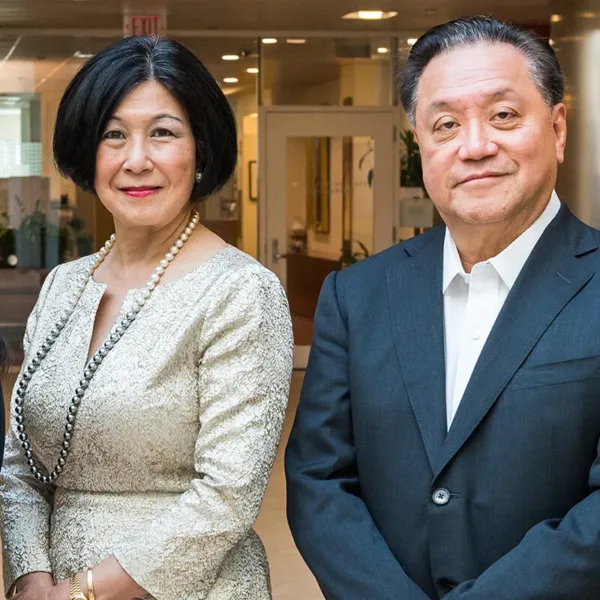
The Yang Tan Collective at MIT was made possible by the vision and generosity of K. Lisa Yang and Hock E. Tan ’75 SM’75, whose commitment to improving human health has transformed basic science research at MIT. Since 2017, Tan and Yang have gifted MIT more than $250 million to create six endowed research centers and multiple endowed fellowship programs.
“In the best MIT spirit, Lisa and Hock have always focused their generosity on insights that lead to real impact,” says former MIT President L. Rafael Reif. “I am deeply grateful to them for making MIT a home of this pivotal research.”
The Yang Tan Collective at MIT comprises six distinct research centers committed to improving human health and wellbeing at a global scale. Within each center, interdisciplinary teams of scientists and engineers join together to address some of the greatest challenges of our time.
Yang Tan researchers are uncovering the genetic, biological, and neurological mechanisms driving conditions from autism spectrum disorders to cystic fibrosis and developing innovative molecular technologies to treat them. They are using sophisticated mathematical models and computational tools to understand complex electrical-neural interactions within circuits, advancing our understanding of the brain. They are exploring the multidirectional interplay between the brain and other body organ systems, paving the way for cutting-edge diagnostics and therapies for gastrointestinal and other dysfunctions. They are creating and disseminating bionic technologies that mitigate a broad range of disabilities. And they identify compelling challenges in resource-constrained communities, then address them through academic innovation to create and translate transformative technologies.
They are, overall, forging a better future for all of us.
Steering Committee
The Steering Committee is comprised of several principal investigators and is tasked with driving collaboration to achieve greater synergy and cohesion amongst the six unique research centers.
- Polina Anikeeva – Director, K. Lisa Yang Brain-Body Center
- Ed Boyden – Co-Director, K. Lisa Yang Center for Bionics; Faculty, K. Lisa Yang and Hock E. Tan Center for Molecular Therapeutics
- Robert Desimone – Director, McGovern Institute for Brain Research
- Guoping Feng – Director, Hock E. Tan and K. Lisa Yang Center for Autism Research; Faculty, K. Lisa Yang and Hock E. Tan Center for Molecular Therapeutics
- Ila Fiete – Director, K. Lisa Yang ICoN Center
- Hugh Herr – Co-Director, K. Lisa Yang Center for Bionics
- Fan Wang – Co-Director, K. Lisa Yang and Hock E. Tan Center for Molecular Therapeutics; Faculty, K. Lisa Yang Brain-Body Center, ICoN Center
- Amos Winter – Director, K. Lisa Yang GEAR Center
- Feng Zhang – Co-Director, K. Lisa Yang and Hock E. Tan Center for Molecular Therapeutics; Faculty, K. Lisa Yang Brain-Body Center, Hock E. Tan and K. Lisa Yang Center for Autism Research
Investing in human capital
To ensure the world’s brightest young scientists and engineers are attracted to the fields of biomedical research and computational neuroscience, Yang and Tan have created twenty-two endowed fellowships across the centers. Several of these fellowships are named in honor of their children Y. Eva Tan and J. Douglas Tan.
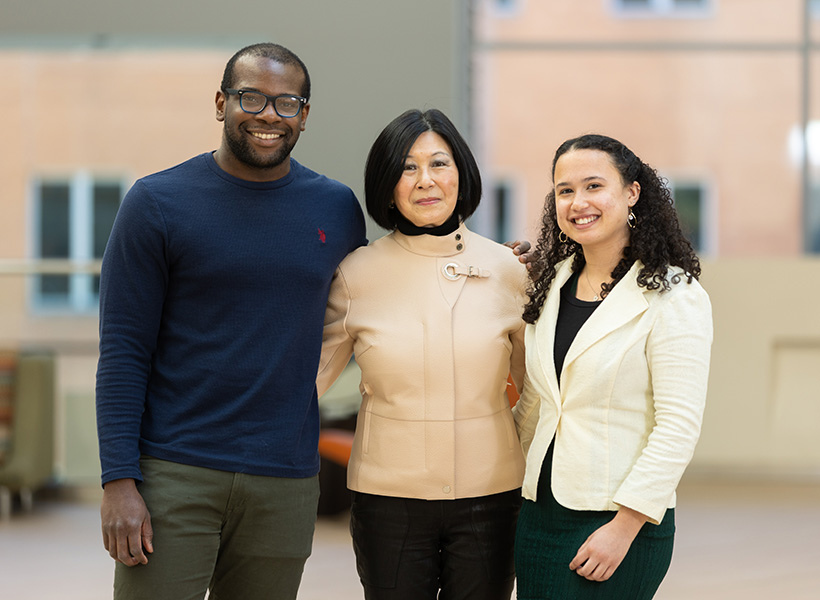
Outstanding graduate students and postdoctoral fellows, reflecting diverse (including neurodiverse) backgrounds with expertise ranging from computer science and biological engineering to neuroscience, receive full fellowships of up to three years, enabling them to fully focus on making groundbreaking discoveries that will have real impact in the very near future. As these endowments increase in value, they will create even more fellowship opportunities in the future.