
Mapping the Brain’s “Uncertain Zone”
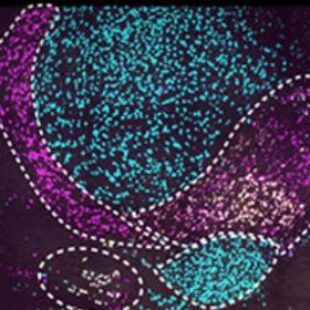
A cellular atlas of the zona incerta points to new therapeutic possibilities.
The zona incerta is a small part of the brain that’s been getting outsized attention from neuroscientists lately. It’s exceedingly well connected, communicating with many other parts of the brain and seemingly contributing to many different kinds of behavior. And there’s reason to believe that stimulating this area therapeutically might be beneficial for patients with certain movement disorders or psychiatric conditions, such as Parkinson’s disease and obsessive compulsive disorder.
The region, whose name means “uncertain zone,” has long been mysterious, and little is known about how neurons there work with the rest of the brain. To guide future research, Yang Tan Collective faculty member and director of the Hock E. Tan and K. Lisa Yang Center for Autism Research, Guoping Feng and his team have generated a detailed cellular atlas of the area, offering researchers a rich source of anatomical, molecular, and physiological information. Their findings were reported April 29, 2026 in the journal PNAS.
“This is a very important brain region we know very little about,” Feng says. “Providing this kind of resource will lead to new ideas and new hypotheses to test. It will also let us look for changes in disease models, to help us understand the pathology of brain disorders.”
Ryan Kast, a former J. Douglas Tan Postdoctoral Fellow in Feng’s lab who led the group’s experiments, explains that the lack of clarity about the zona incerta’s role comes in part from the many different functions that it has been linked to in animal studies. These include movement, pain sensing, feeding, novelty seeking, and defensive behaviors. “The list is very long,” Kast says. “It’s perhaps a shorter conversation to ask what zone incerta doesn’t do.”
One goal scientists have is to understand how different types of neurons within the zona incerta contribute to the region’s many functions. Cells in the brain are so diverse, there is no single method of sorting them into definitive types. So Kast and colleagues profiled cells in the zona incerta of the mouse brain according to three key features: their patterns of gene activity; their connections to other parts of the brain; and their electrical activity.
The researchers found one commonality among the neurons of the zona incerta: According to their analysis of individual cells’ genetic activity, all of the neurons there are inhibitory neurons. This means the signals the zona incerta sends to other parts of the brain dampen the activity of other neurons.
The team’s analyses allowed them to clearly define, for the first time, the boundaries of the zona incerta and identify four subregions within it. Using genes that are uniquely switched on within each subregion, the team was able to develop genetic tools that researchers can use to target each of these subset of zona incerta neurons in future experiments.
But even within these groups, the team uncovered a great deal of diversity. Tracing the anatomical connections to and from the zona incerta, the team showed how groups of neurons that reach out to communicate with the same part of the brain did not necessarily share the same properties. “Within these projection pathways, there are distinct subsets of cells that clearly process their inputs differently,” Kast says, explaining that this adds complexity to the zona incerta’s influence over signaling elsewhere in the brain.
Kast also zeroed in on two groups of zona incerta neurons to explore their impacts on behavior. He set up an experiment in which mice would need to call on several brain circuits thought to be influenced by the zona incerta: those that motivate an animal to eat; those that respond to fear; and those that control movement. He monitored the activity of those cells as the animals were confronted by a looming shadow suggesting a potential predator as they ate. The signals he detected seemed to be tied to the animals’ movements as they decided to either continue eating or flee from the threat.
Kast says further functional studies will be essential for understanding the zona incerta. He points out that the zona incerta shares key features with the basal ganglia, a better studied brain structure that sends inhibitory signals to many of the same parts of the brain. He’s curious why both structures are needed and what makes them distinct. “Trying to place the role of the zona incerta into the whole architecture of the brain feels like the next biggest priority,” he says.
With a new map for exploring this influential part of the brain, Kast and Feng hope researchers will uncover information that will lead to more precise interventions for neurological and psychiatric conditions. Clinical studies have indicated that deep brain stimulation targeting the zona incerta can reduce symptoms of Parkinson’s disease and essential tremor, and the region is also considered a potential target for treating epilepsy and obsessive compulsive disorder.
The laboratories of Fan Wang and Ian Wickersham at MIT, and Joshua Levin and Zhanyan Fu at Broad Institute have also contributed to this study. This work was supported by Yang Tan Collective at MIT, the Hock E. Tan and K. Lisa Yang Center for Autism Research at MIT, the Poitras Center for Psychiatric Disorders Research at MIT, and the National Institute of Mental Health of NIH.