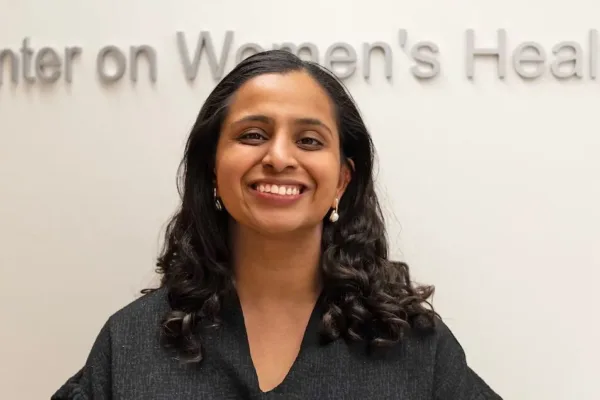
Nagina Mangal, 2023-2025 K. Lisa Yang and Hock E. Tan Center for Molecular Therapeutics
News Type


Probing the biology of brain circuitry
For as long as she can remember, Nagina Mangal has loved science. Now she is channeling her skills as a molecular and cellular biologist to understand brain circuitry and, hopefully, open doors to improved therapies for neurologic and neuropsychiatric disorders.
Mangal, a Y. Eva Tan Postdoctoral Fellow, is conducting research in the laboratory of Ann Graybiel, an institute professor at MIT. Mangal and her colleagues are studying the striatal region of the forebrain, which is essential for motor control, emotions, and other behaviors. When dysfunctional, this large region is associated with such disorders as Parkinson’s and Huntington’s disease, autism spectrum disorder, addiction, impulsivity, and depression. The neurotransmitter dopamine plays an important role in these neural circuits.
“We’re trying to work out the circuitry in the striatum, because knowing the fundamental biology leads to therapeutics,” she says.
Mangal is building on her earlier research on the endocannabinoid system, an endogenous signaling system important for regulating learning, memory, mood, sleep, appetite, and other critical bodily functions. For one of her postdoc projects, she’s investigating the role of CB1 receptors — the most highly expressed GPCR (G protein–coupled receptor) — in the brain.
Graybiel’s lab previously discovered that when the CB1 receptor is knocked out in mice, a cell structure that resembles a bouquet of flowers, topped by dopamine “petals,” withers at its stem-like section. Mangal says they’re eager to know, “Why are these bouquet structures withering when CB1 is knocked out?”
“I hope my research will answer the questions: Is CB1 important in the brain? Is it changing dopamine circuitry? How can we take the basic biology that we know from in vivo studies and translate that to therapies for Parkinson’s and other disorders?”
Starting from scratch
Early in her life, Mangal moved from Afghanistan to London; she spoke barely any English, but there were more opportunities for 6-year-old Mangal and her sister. “We had nothing. We started from scratch, and I worked my way up,” she recalls. “I found that the more science I learned, the less I knew — and this got me hooked.”
She earned a bachelor’s degree in biochemistry from the University of London, a master’s of research in stem cells and developmental biology from the University College London, and a PhD in clinical medicine research from Imperial College London in 2023. Her doctorate highlighted the effects of the endocannabinoid system on pancreatic cancer.
Mangal’s research interests led her to a journal paper of Graybiel’s on the CB1 receptor in the striatum, eventually joining Graybiel’s team for her postdoctoral training with critical support from the Y. Eva Tan Postdoctoral Fellowship.
“I am thrilled that this fellowship exists and delighted to be part of the Yang Tan Collective community,” Mangal says. “I’m very grateful to Ms. Yang and Mr. Tan for their immense support.”