Christopher Shallal
News Type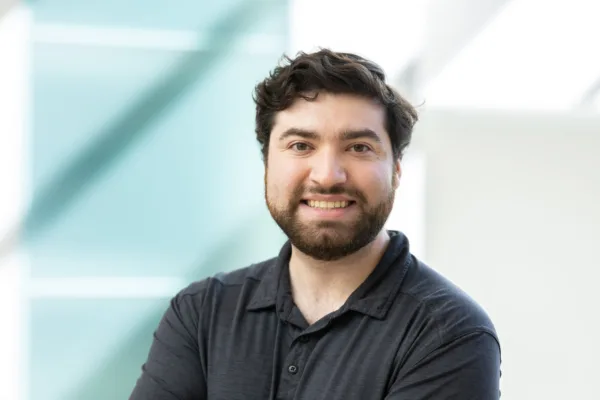


Prosthetics you don’t have to think about
Earlier generations of prosthetic limbs were purely mechanical, dependent on “some really unnatural movements” for control, Shallal says. Even today’s robotic limbs involve extremely unreliable electrodes.
Shallal, a PhD student in the Harvard–MIT Program in Health Sciences and Technology and a 2025–2026 MIT Health and Life Sciences Collaborative (HEALS) Fellow, is part of a team designing the interface for next-generation robotic prosthetics. His interface uses tiny, paired implanted beads — each the size of a sesame seed — to directly read muscle movements, communicate with small computers built into the prosthetic limb, and translate those readings into movement.
Shallal notes, “This innovation allows a person to control a prosthetic device using their residual neural signals,” making bionic limbs nearly as intuitive to use as biological limbs.
Shallal’s technology takes advantage of the body’s natural mechanics. Biologically, human muscles work in opposing pairs that pull against each other like a pulley. This mechanism creates movement across a joint and provides the brain with feedback.
“These muscle pairings allow us to know where our limbs are in space,” he explains. “But when someone has a traditional limb amputation, those muscle pairs are sutured down to the bone, so the patient loses that sense of where the limb is.”
Combining the Herr lab’s novel agonist-antagonist myoneural interface surgery, which preserves natural muscle pairings, with tiny implanted beads and an electronic interface has resulted in a closed-loop system that restores natural proprioception and enables nearly effortless control of robotic limbs. Three patients have been outfitted with the new interface and protocol; Shallal and his team are on their way toward completing the first phase of their clinical trial.
“The best part of creating cutting-edge prosthetics is working with patients,” says Shallal. “This work is deeply human.”
Shallal, who has bilateral lower-leg amputations himself, looks forward to benefiting from his own work.
“None of my own current devices are controlled by my muscles or neural inputs. The prosthetics I’m using now are more like hydraulics and springs, and now we’re putting motors in them,” he notes. “I’ve already benefited from this technology, but progress is exponential. Where will bionic limbs be in 20 years? I can’t wait to be part of the journey.”