From green fields to green energy
News Type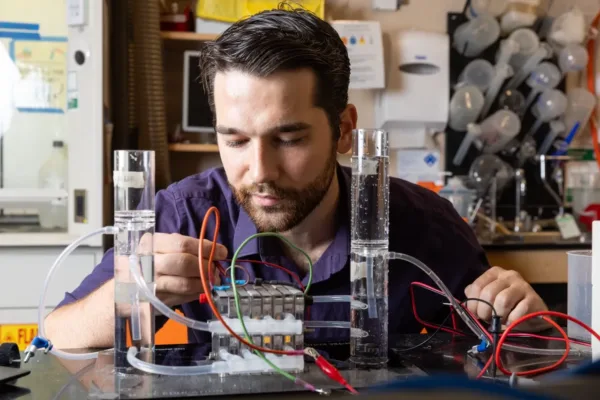
Photo: Steph Stevens
Collin Goldbach’s interest in engineering has taken him from building compact tractors for small
farmers to designing new ways for heavy vehicles to run on cleanly produced hydrogen fuel.


Growing up, Collin Goldbach used his creativity and tool-building skills to solve problems on his family’s farm. Now he’s applying them to global challenges like climate change.
On the rural Wisconsin farm where Goldbach grew up, something always needed fixing. Even as a child, Goldbach found ways to pitch in. “I learned how to cut two pieces of metal in half, and I learned how to weld them back together. And then I was just making stuff,” he recalls.
The satisfaction he found in crafting new tools — sometimes practical ones but also swords and other objects that captured his boyhood imagination — inspired Goldbach to pursue a career in mechanical engineering. He attended the University of St. Thomas, Minnesota, intending to earn an undergraduate degree and be done with school forever. But when he mentioned an interest in teaching, an influential professor encouraged him to consider a career in academia.
That led Goldbach to head to MIT as a PhD student in mechanical engineering. He spent his first few years converting a motorcycle into a compact tractor — a useful machine for smallholder farmers in India, who typically lack resources to own tractors and must hire equipment or use draft animals to till fields.
Now a member of the K. Lisa Yang GEAR Center at MIT, Goldbach has turned his attention to hydrogen energy systems. Hydrogen fuel produces no climate-altering emissions but is impractical due to its bulk and high transport costs. Goldbach is exploring ways to make cleanly produced hydrogen a practical solution for powering heavy vehicles like buses and trucks.
He also makes time for teaching, something he has loved since his undergraduate days at the University of St. Thomas. At MIT he helps students in the famed 2.007 design and manufacturing course prepare for a year-end robotics competition — a challenge that draws out a great deal of creativity and problem-solving.
Goldbach appreciates the conveniences of life in Boston, but he still feels pulled toward quieter, more natural settings. He often spends weekends in the mountains or along the coast, seeking opportunities for hiking, camping, and rock climbing. The White Mountains, with their 48 peaks above 4,000 feet, are a frequent draw. He’s reached the top of about half of them so far — and plans to keep on climbing.