Uncovering the genetic roots of autism’s sex bias
News Type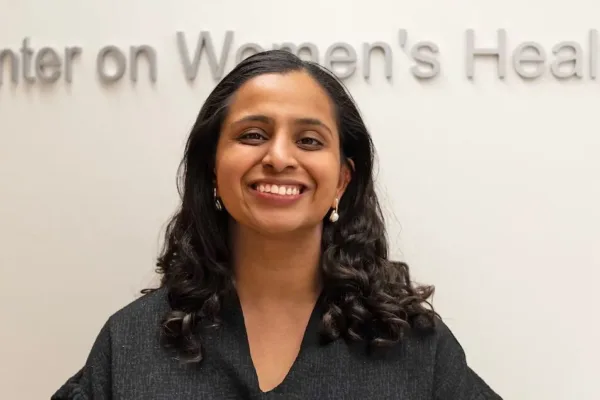
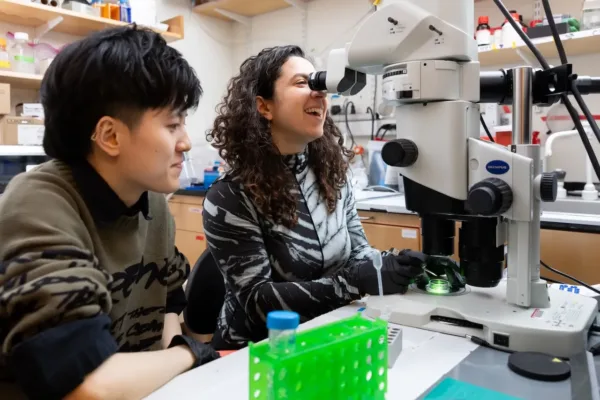
Maya Talukdar uses 2D neuron cultures to study why males are nearly four times as likely to develop autism than females. Photo: Rebecca Andersen


Maya Talukdar has long been drawn to the intersection of the brain, biology, and identity. Now, as an MD/PhD student in the lab of Christopher Walsh at Boston Children’s Hospital, she is tackling a compelling question in autism research: Why are males diagnosed much more often than females?
Autism is among the most strongly male-biased conditions in medicine. For every female diagnosed, roughly four males receive the same diagnosis. The genetic underpinnings of this gap remain poorly understood. Talukdar, a computational biologist by training, approaches the problem through bioinformatics and statistical modeling, collaborating with wet-lab colleagues to bridge computational insights and experimental findings.
At the heart of her research in the Hock E. Tan and K. Lisa Yang Center for Autism Research at Harvard is a phenomenon researchers call the “female protective effect.” Studies have consistently found that females with autism tend to carry a higher burden of autism-associated genetic variants than males with the same diagnosis. In other words, females appear to require more genetic risk to manifest autism, suggesting that female biology may protect against the effects of those variants.
“The basis of this female protective effect is unknown,” Talukdar says. “By understanding the genetic factors that make females more resilient to autism-associated variation, we hope to gain novel insights into the pathophysiology of autism that will ultimately benefit anyone with autism.”
She emphasizes that the aim is not to “cure” autism but to deepen our understanding of its genetic architecture, including how to better support people with autism who have significant challenges.
Her path to this research was shaped by years of working with children with different abilities, which fostered her interest in neurodevelopment. Early in grad school, a lecture by David Page on the genetics of sex chromosomes ignited Talukdar’s fascination with biological sex differences. “Studying the male bias of autism was a natural way to unite those interests,” she says. “This is such a complex problem that new questions emerge for each one we answer — it is both daunting and thrilling!”
Talukdar plans to complete her clinical training and pursue a career as a physician-scientist focused on clinical genetics and maternal-fetal medicine. She envisions a practice at the intersection of gene therapy, precision diagnosis, and treatment of congenital disorders.
She notes, “The best science is that which crosses disciplines, and that is exactly the ethos of the Yang Tan Collective.”