Rooted in inquiry
News Type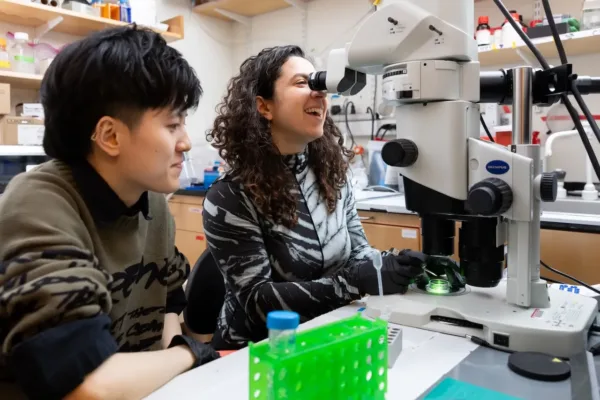
Postdocs Yasu Xu (left) and Shahar Bracha (right) bring remarkably different backgrounds to a shared mission at MIT: engineering revolutionary biomedical tools that could transform medicine, from brain imaging to organ transplantation. Photo: Steph Stevens


Despite radically different beginnings, neuroscientist Shahar Bracha and physicist Yasu Xu collaborate to push the boundaries of biomedical engineering.
Shahar Bracha’s path to MIT began in Israel, where she entered Tel Aviv University at age 15 to study philosophy. Around the same time, Yasu Xu was in China, studying materials physics at Wuhan University. From these diverse origins, the scientists found their way to the field of synthetic neurobiology. As postdoctoral fellows in the K. Lisa Yang and Hock E. Tan Center for Molecular Therapeutics in Neuroscience at MIT, they apply their complementary perspectives to build the next generation of biomedical tools.
For Bracha, science was a natural extension of the kind of inquiry that she found in her philosophy classes. Both involved postulating descriptions of the world, investigating their implications, and refining models to get closer and closer to truth. And the truths she learned she most wanted to pursue were biological ones. She earned a PhD in neuroscience, reengineering a brain-infecting parasite to deliver drugs to the brain. After graduating, she cofounded a cell- and gene-therapy company, Epeius Pharma, that is advancing that approach.
Xu, on the other hand, was drawn to physics, with its rules and equations, because she appreciates a sense of structure. But her interests quickly pulled her into a less orderly realm. As a graduate student in biophysics, she began engineering programmable genetic circuits. With that shift toward biology, her experiments became less predictable: “Even a very simple thing never functions as easily as we would expect for an electronic device,” she says. But she embraced the complexity.
Now postdocs in the Yang-Tan Center for Molecular Therapeutics, Bracha and Xu are working at the frontier of biomedical engineering, designing technologies and methods that expand the possibilities of modern medicine. Working with mentor Ed Boyden, the Y. Eva Tan Professor of Neurotechnology at MIT, they’ve streamlined a process for optimizing molecular tools that are introduced through an animal’s genome — like sensors for visualizing brain activity — by eliminating the need to run preliminary screens in lab-grown cells. They are also looking to animals who hibernate through hard winters to uncover molecules that might be adapted to keep organs healthy in cold storage, with the goal of increasing the availability of donated organs for transplant.
Xu and Bracha haven’t lost sight of their earlier interests and inclinations. Bracha continues to study philosophy and hosts a weekly salon in her home. Inspired by Talmudic study, participants read philosophical texts aloud and “argue about everything” until they understand the text better. Xu carries with her the precision and attention to detail that first drew her to physics. She loves to work with Legos to build mechanical structures that incorporate practical engineering principles. Her other love is coffee — not for its quick caffeine hit but for its nuanced flavors and the craft involved in its preparation.