Sreeparna Pradhan, 2022-2024 K. Lisa Yang Brain-Body Fellow
News Type


Investigating gut-brain communication
Anyone who has felt “butterflies in the stomach” from being excited or anxious knows there’s a palpable link between our digestive system and brain. But exactly how these two parts of the body’s nervous system “talk” to each other isn’t fully clear.
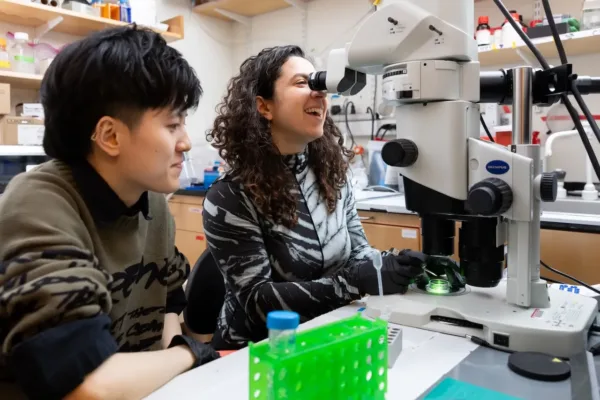
Sreeparna Pradhan, a postdoctoral fellow in the K. Lisa Yang Brain-Body Center, is providing more clarity by studying the role of neuropeptides in gut-brain communication in Caenorhabditis elegans, a transparent worm used as a model organism in research. She’s doing so in the lab of Steven Flavell, an associate professor of brain and cognitive sciences.
Understanding this two-way interplay opens the door to potential therapies for conditions with gastrointestinal symptoms, from autism spectrum disorder to Parkinson’s disease to depression and anxiety.
Neuropeptides are small proteins that help neurons communicate. Although neurons typically connect through synapses when they are close together, they can also “talk” from farther away by releasing peptides that act as neurotransmitters, or chemical messengers, Pradhan explains. Scientists have mapped all 302 neurons and thousands of synapses in C. elegans, but its network of neuropeptides is less well-known.
Pradhan’s current research examines how microorganisms in the digestive system affect the brain. This entails feeding the worms pathogenic bacteria, tracking the animals’ behavior as they become ill — including eating less and slowing down — and using genetically engineered strains to locate the signals coordinating communication between gut and brain. The team has identified a number of neuropeptides involved in this process; Pradhan is investigating which neurons are releasing them, as well as changes in the worms’ brain activity.
“I am very excited about this project,” she says. “It contributes to our understanding of the mechanisms by which gut bacterial infections can influence the brain and behavior. We found that neuropeptide systems can be integral to this cross talk.”
Thinking big
Raised in Kolkata, India, Pradhan earned bachelor’s and master’s degrees in biotechnology and pursued her PhD in neuroscience at McGill University, in Montreal. There, she studied how stressful early experiences like starvation can have long-lasting effects.
At McGill, Pradhan imaged individual C. elegans neurons but wanted a bigger-picture understanding of brain-body communication and its impact on disease and health. The Flavell lab, which she joined in November 2020, was an ideal destination because it has developed technology to image the whole nervous system of freely moving C. elegans using a video tracker and machine learning tools.
How can this nematode inform human health? Many of the genetic pathways in both C. elegans and humans have been “conserved” through evolution and uphold the same principles of communication. “Studying simple invertebrate systems,” Pradhan points out, “has yielded foundational discoveries in many areas of biology.”
Pradhan is deeply grateful for the inaugural K. Lisa Yang Brain-Body Postdoctoral Fellowship, especially as an international scientist. Her future plans include investigating bacterial communication in the intestine and neuropeptides’ role in regulating sleep in animals. “I plan on becoming a tenure-track professor and pursuing some of these ideas in my own lab,” she says.