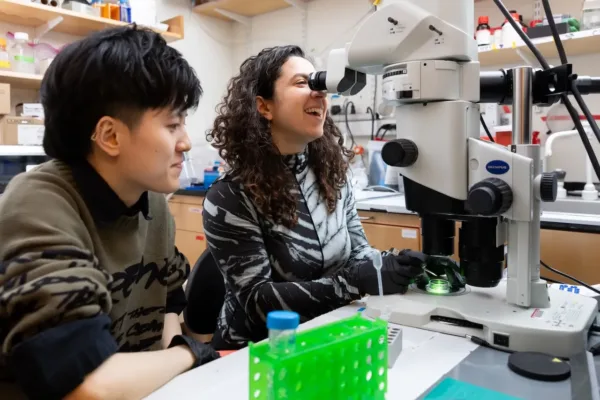
Kara Fulton
News Type


Investigation sensory-guided behaviors
“Many natural behaviors exhibited by animals display a continuous cycle of sensation and action,” Fulton explains. “This loop allows an animal to flexibly update its actions in response to stimuli through learning.”
Her research focuses on understanding the neural circuits that process sensory information and coordinate movement to facilitate exploration, work that has significant implications for understanding autism spectrum disorder (ASD) and other neurodevelopmental conditions.
Fulton earned her PhD in neuroscience from Brown University. There, she developed high-throughput methods for correlative electron microscopy and investigated the functional and structural wiring specificity of interneurons in the olfactory bulb.
In Harvard’s Hock E. Tan and K. Lisa Yang Center for Autism Research, she has made remarkable discoveries about how mice learn from social interactions, particularly through what’s known as social transmission of food preference. This phenomenon allows mice to learn about the safety of foods through associations formed between body odors of other mice and food odors.
“We’ve identified a circuit involving a subset of olfactory bulb projection neurons that support this type of social learning,” she says. “This represents an unconventional circuit embedded in themain olfactory system.”
Through a sophisticated series of experiments, Fulton and her colleagues demonstrated that this circuit is both necessary and sufficient for forming food preferences through social learning. Using optogenetic activation and inhibition techniques, they were able to manipulate the subset of olfactory bulb projection neuron axons and observe the effects on social learning.
The anatomical tracing performed by Fulton’s team revealed that olfactory projection neurons interact with cholinergic neurons in the basal forebrain, which then project to higher brain regions such as the hippocampus— which is essential for learning and memory.
“Our tracing indicates that the circuit underlying social transmission of food preference likely also recruits neuromodulatory neurons to influence learning in other contexts, such as spatial navigation,” Fulton notes.
“I’m hoping this work will contribute to our fundamental understanding of how sensory information guides behavior in both typical development and neurodevelopmental disorders.”