Turning curiosity into care
News Type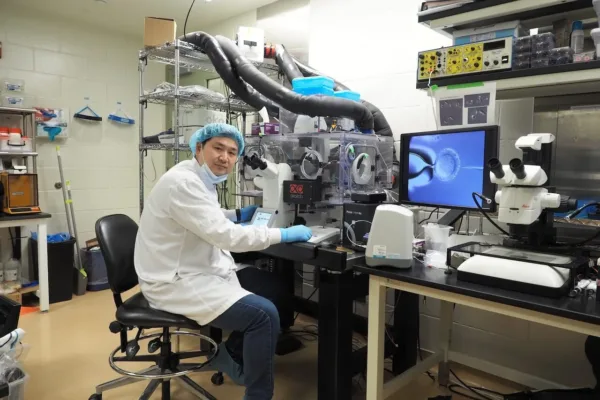
Qiangge Zhang develops genetically engineered animal models to help scientists better understand autism, Alzheimer’s disease, and other brain disorders — with the goal of advancing new therapeutic approaches. Photo: Qun Liu


It took some time for Qiangge Zhang to be inspired by biology. Today, he’s passionate about probing unsolved mysteries of the brain and the potential for his work to impact the lives of autistic people and their families.
When Qiangge Zhang learned that he’d been admitted to college for biology, he was disappointed. He’d wanted to be a scientist since he was a child, but his high school classes made it seem like biology was mostly about categorizing plants and animals. He wanted to discover and build new things, and he had hoped to pursue a career in electrical engineering.
Zhang’s first year of college was a struggle, as the introductory courses on zoology held no interest for him. But he found another world on the library shelves. Zhang read James Watson’s account of the discovery of DNA’s iconic structure, The Double Helix, and understood that the dawn of molecular biology had revolutionized the field. “Then I was hooked,” he says. Biology was a modern science, he realized, and there was plenty left to be discovered.
Zhang earned a PhD in cellular and molecular biology at the Shanghai Institutes for Biological Sciences and eventually found his way to neuroscience, drawn to it because he found the mysteries of the brain so alluring. Today, he is combining his training with his early interest in engineering and using them to develop new animal models of brain disorders. As the transgenics group leader in the Hock E. Tan and K. Lisa Yang Center for Autism Research at MIT working in the labs of Guoping Feng and Robert Desimone, Zhang uses genetic engineering to develop nonhuman-primate models that enable researchers to pursue a deeper understanding of autism, Alzheimer’s disease, and other conditions, along with opening new opportunities for potential therapeutics.
For Zhang, who has seen how autism can create stress and challenges for families, the work is deeply motivating. “If I can do something to help people, then I feel like my life is more meaningful,” he says. But science isn’t just work for Zhang. He says it’s also his hobby. When he takes time away from home on evenings or weekends, he can usually be found back on campus. His two children, 12 and 15, are equally comfortable there, having grown up participating in the lab’s social events. “My wife never worries about where I go,” he laughs. “She knows I will be in the lab, not in the club.”